ℹ️ Quick Answer: Universal high income is Elon Musk’s prediction that AI and robots will produce so much wealth that poverty disappears and saving money becomes pointless. He says it could happen in 10 to 20 years. Economists and politicians like Bernie Sanders are pushing back hard on the timeline and the lack of any concrete funding plan.
📋 WHAT’S INSIDE
- What Elon Musk Actually Said About Universal High Income
- Universal High Income vs. Universal Basic Income
- When Does Musk Think This Will Happen?
- How Would Universal High Income Actually Work?
- Bernie Sanders Asks the Question Everyone’s Thinking
- Why Economists Are Skeptical
- What This Means for You Right Now
- The Question of Meaning
The world’s richest person just told you to stop saving money. Should you listen?
⚠️ Keep saving anyway. Musk might be directionally right about automation changing work, but even if his vision arrives in 2045, you still need to pay rent in 2026. No concrete funding plan exists, and even Musk admits there will be “a lot of trauma and disruption along the way.”
I’ve been tracking AI predictions for this blog since it started, and this one sparked the most debate I’ve seen. Senator Bernie Sanders called Musk out publicly. Economists pushed back on the timeline. And regular people are wondering if the richest man alive is actually seeing the future or just wildly out of touch. So what did he actually say, and what does it mean for you?
What Elon Musk Actually Said About Universal High Income
On December 17, 2025, Musk responded to a post about Trump savings accounts for newborns by saying “there will be no poverty in the future” and “no need to save money” because AI and robots will deliver “universal high income.”
The statement that got everyone talking came when Musk responded to a post about “Trump accounts,” a new government savings program for newborns. Billionaire investor Ray Dalio had announced he’d contribute $250 to accounts for 300,000 children.
Musk’s response? “It is certainly a nice gesture of the Dells, but there will be no poverty in the future and so no need to save money. There will be universal high income.”
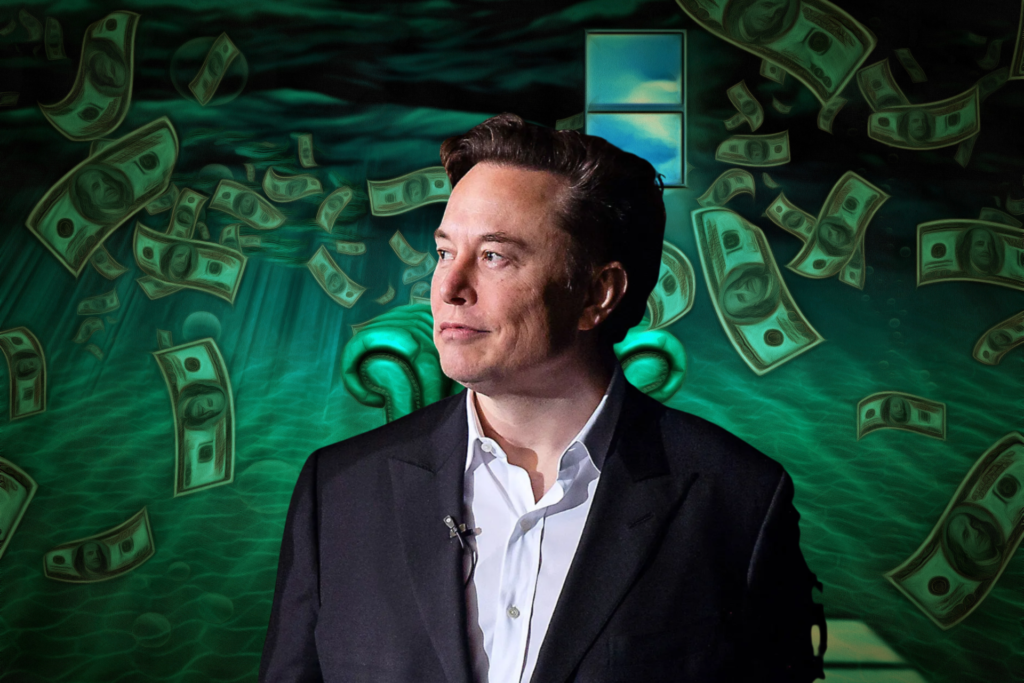
In a follow-up post, he added: “The future is going to be amazing with AI and robots enabling sustainable abundance for all!”
This wasn’t a one-off comment. Musk has been building toward this vision for years, with increasingly specific predictions about timelines and how it might work.
Universal High Income vs. Universal Basic Income: What’s the Difference?
Universal basic income (UBI) covers survival needs like food and housing. Universal high income, Musk’s term, means AI-driven prosperity for everyone. Not just scraping by but living well, with goods and services so abundant that money itself becomes unnecessary.
You’ve probably heard of universal basic income (UBI), the idea that governments should give everyone enough money to cover basic needs like food and housing. Musk is proposing something bigger.
At the VivaTech conference in Paris in May 2024, Musk explained the distinction: “There will be universal high income, and not universal basic income, universal high income. There’ll be no shortage of goods or services.”
The difference matters. UBI covers survival. Universal high income, in Musk’s vision, means prosperity for everyone. Not just scraping by, but actually living well.
On the “People by WTF” podcast, Musk went even further: “I think money disappears as a concept, honestly. In a future where anyone can have anything, you no longer need money as a database for labor allocation.”
When Does Musk Think Universal High Income Will Happen?
Musk predicts work becomes optional within 10 to 20 years, with an 80% probability that AI eliminates the need for human jobs. Tesla’s Optimus robot, priced at $20,000 to $30,000, is his proposed first step.
Musk has given specific timelines, though they’ve varied slightly:
- 10 to 20 years until work becomes optional
- 80% probability that AI creates conditions where humans don’t need jobs
- 2025 is when Tesla plans to have “over 1,000, or a few thousand” Optimus robots working in its factories
“My prediction is that work will be optional,” Musk said at the U.S.-Saudi Investment Forum. “It’ll be like playing sports or a video game or something like that.”
How Would Universal High Income Actually Work?
The idea is that AI and robots become so productive that goods and services cost nearly zero, scarcity disappears, and money itself becomes unnecessary. Musk compares it to Iain M. Banks’ “Culture” novels but hasn’t provided a concrete blueprint.
This is where things get vague. Musk has painted a picture, but he hasn’t drawn a blueprint.
The basic idea: AI and robots become so productive that the cost of goods and services drops to nearly zero. When robots can build houses, grow food, provide healthcare, and manufacture everything we need, scarcity disappears. And when scarcity disappears, so does the need for money.
Musk referenced the “Culture” science fiction book series by Iain M. Banks, describing it as “the most realistic and best envisioning of a future AI.” In those books, superintelligent AI runs a utopian society where money doesn’t exist.
“If AI and robotics are big enough to satisfy all human needs, then money is no longer necessary,” Musk explained.
Tesla’s Optimus robot, priced around $20,000 to $30,000, is supposedly the first step. Musk claims it could eventually “eliminate poverty” and perform countless household and industrial tasks.
Bernie Sanders Asks the Question Everyone’s Thinking
Senator Bernie Sanders publicly challenged Musk’s vision on X, asking how this “utopia” would help the tens of millions of workers who lose their jobs during the transition. Musk called Sanders a “coward.” Sanders fired back about the real-world consequences.
Senator Bernie Sanders didn’t let Musk’s vision go unchallenged. In a video posted to X on December 17, Sanders directly confronted the contradictions.
“You have told us poverty will be wiped out, work will be optional,” Sanders said. “How will this utopia come about?” He pressed Musk on what happens to entry-level jobs and when people would actually see the “free housing” and healthcare that robots supposedly enable.
The exchange got heated. Musk called Sanders a “coward” who lacked “any sense of adventure.” Sanders fired back: “Yes, Elon. I do lack ‘any sense of adventure’ when that ‘adventure’ will, as you have made clear, force tens of millions of workers out of their jobs.”
Sanders added: “The goal of AI and robotics must be to improve life for all people, not just to make you and your fellow oligarchs even richer.”
Why Economists Are Skeptical About Universal High Income
University of Pennsylvania economist Ioana Marinescu and the Yale Budget Lab both dispute Musk’s timeline, noting that the labor market has shown no measurable AI disruption since ChatGPT’s launch and that no funding mechanism exists for the transition.
Not everyone is buying Musk’s timeline or his optimism.
Ioana Marinescu, an economist at the University of Pennsylvania, agrees that full automation could eventually happen. But she’s “dubious about his timeline.” A Yale Budget Lab report from October found that since ChatGPT’s release, the “broader labor market has not experienced a discernible disruption” from AI automation.
The practical problems are significant:
- Robots are expensive. While AI software costs keep dropping, physical robots like Tesla Optimus remain expensive to manufacture and maintain
- No funding mechanism. Musk hasn’t explained how universal high income would be paid for during the transition
- Political barriers. Redistributing wealth on this scale would require massive political changes
- The “in between” period. Even Musk admits “there will be a lot of trauma and disruption along the way”
Billionaire investor Vinod Khosla offered a darker warning. He agreed that AI will outperform humans at most jobs, but cautioned that without intervention, the result could be “economic dystopia, with wealth concentrating at the top while both intellectual and physical labor are devalued.”
What This Means for You Right Now
Keep saving for retirement. Even if Musk is directionally right about automation changing work over the coming decades, the transition period is the problem, and you still need to pay rent in 2026.
Should you stop saving for retirement because Elon Musk says money will be meaningless? Absolutely not.
My honest take: Musk may be directionally correct that AI and automation will dramatically change work over the coming decades. But the transition period is the problem. Even if universal high income arrives in 2045, you still need to pay rent in 2026.
What you can do is start paying attention to how AI is already changing things. If you want to understand the practical ways AI can help you today, not in some theoretical future, check out our AI Life 2026 series for real applications you can use now.
AWS CEO Matt Garman recently called the idea of replacing junior employees with AI “one of the dumbest ideas” that will “explode on itself.” There’s clearly no consensus among tech leaders about how this transition will play out.
The Question of Meaning
If AI makes work optional, the bigger question becomes what humans do with their time and how they find purpose. Musk himself acknowledged this at VivaTech when he asked whether life has meaning if computers can do everything better.
There’s one part of Musk’s vision that doesn’t get enough attention. At VivaTech, he asked: “If the computer and robots can do everything better than you, does your life have meaning?”
He suggested humans might still have a role: “I do think there’s perhaps still a role for humans in this, in that we may give AI meaning.”
Whether universal high income arrives in 15 years or 50, this question isn’t going away. If work becomes optional, what do we do with our time? How do we find purpose? These are questions worth thinking about regardless of the timeline.
Common Questions About Universal High Income
What exactly is universal high income?
Universal high income is Elon Musk’s term for a future where AI and robots are so productive that everyone can afford not just basics but actual comfort and prosperity. It’s different from universal basic income, which focuses on covering minimum survival needs. Musk envisions a world where goods and services are so abundant and cheap that traditional money becomes unnecessary.
When does Musk predict universal high income will arrive?
Musk has said work could become optional in 10 to 20 years, with an 80% probability that AI creates conditions where humans don’t need jobs. Tesla plans to have thousands of Optimus robots working in its factories by 2025, with millions planned for production in the coming years.
Should I stop saving money because of Musk’s universal high income prediction?
No. Financial advisors strongly recommend continuing to save regardless of Musk’s optimistic predictions. Even if some version of universal high income eventually arrives, the transition period could take decades, and no concrete funding mechanism or policy framework exists yet. Plan for the world we have, not the one Musk imagines.
How would universal high income be funded?
Musk hasn’t provided specific details. The general idea is that AI and robots become so productive that the economy grows by 10x to 100x, making goods and services essentially free. Critics point out this lacks a concrete blueprint and ignores the political and economic challenges of transitioning from our current system.
Musk’s predictions are worth watching, even if you shouldn’t bet your retirement on them.
Related reading: AI Life 2026: How to Tailor Your Resume | AWS CEO Says Replacing Junior Employees with AI Is One of the Dumbest Ideas | New to AI? Start here
WHO WROTE THIS
Moses Smith. I write Everyday AI for people who aren’t engineers. I go try the tools, then tell you honestly whether they were worth it. Sometimes the answer is no, and that’s kind of the point.
This blog is free and has no ads. If it saved you some time, you can buy me a coffee.