ℹ️ Quick Answer: NVIDIA humanoid robots train entirely in virtual simulations, then transfer those skills to physical bodies with zero real-world practice. Their Isaac Sim platform runs thousands of parallel environments on GPUs, compressing years of robotics learning into hours. CEO Jensen Huang predicts factory deployment within a few years at $100,000 per unit.
📋 WHAT’S INSIDE
- What NVIDIA Actually Built for Humanoid Robots
- Jensen Huang’s Bold Prediction for NVIDIA Humanoid Robots
- The Skeptic Who Says NVIDIA Humanoid Robots Are Overhyped
- Why NVIDIA Humanoid Robots Matter for Regular People
- My Take on NVIDIA Humanoid Robots
- Common Questions About NVIDIA Humanoid Robots
NVIDIA humanoid robots can now learn to walk perfectly in a virtual world, then step into reality without stumbling once. No physical practice. No trial runs. Just millions of simulated falls in a digital sandbox, then a flawless debut in the real world. This is happening right now, and it’s compressing years of robotics research into hours.
I watched a demo video last week that I can’t stop thinking about. A humanoid robot trained entirely in simulation walked across uneven terrain like it had been doing it for years. The thing is, it had never touched actual ground before that moment.
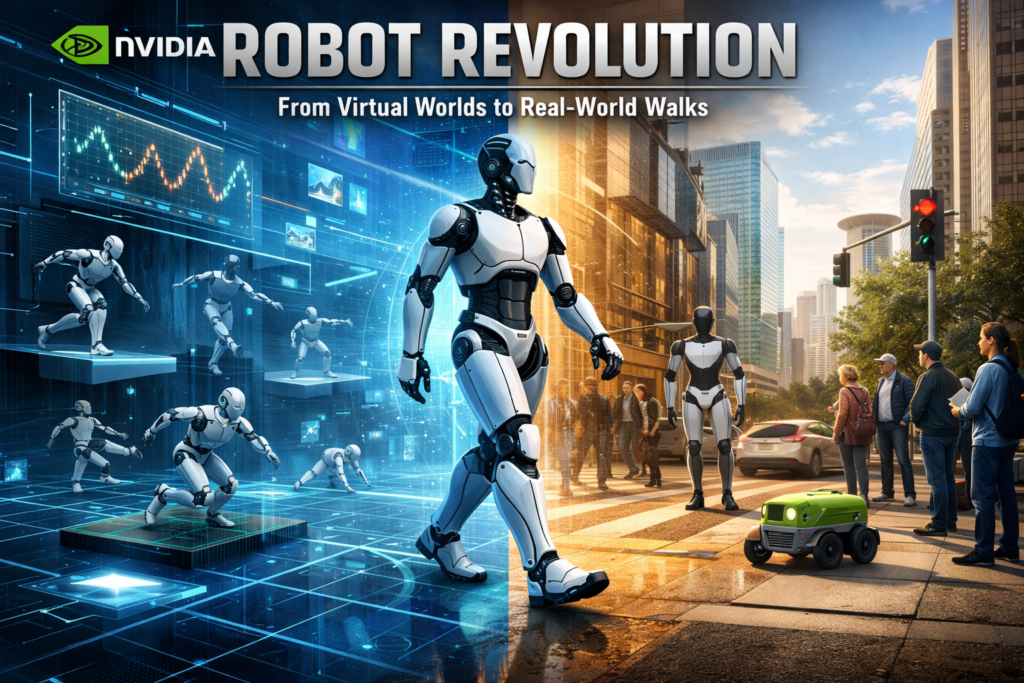
NVIDIA calls this “zero-shot sim-to-real transfer.” The concept is wild. Train robots in hyper-realistic virtual worlds, then deploy them to physical reality with zero additional real-world training. If this actually works at scale, everything we thought we knew about how robots learn is about to change.
What NVIDIA Actually Built for Humanoid Robots
Traditional robot training is brutal. You build an expensive machine, watch it fall and break things for months, repair it constantly, and slowly teach it through painful physical trial and error. It’s slow. It’s expensive. And it’s why we don’t have robots walking around our homes yet.
NVIDIA’s approach flips this completely. Their Isaac Sim platform runs thousands of virtual environments simultaneously on powerful GPUs. Imagine a thousand parallel universes where a robot is learning to walk, each exploring slightly different conditions. One version is on carpet. Another on gravel. Another gets pushed unexpectedly. They all learn from each other’s mistakes.
The physics simulation is obsessively accurate. Every detail from gravity and friction to joint limits and contact dynamics gets modeled so the virtual world mirrors reality closely enough that skills transfer directly. At least, that’s the theory.
The real magic is in the falling. A robot can “fall” millions of times in simulation, explore edge cases that would be impossible to test in real life, and learn from failures that would cost thousands in repairs. One second of simulated training reportedly equals about 27 minutes of real-world experience. That math is staggering if it holds up.
Jensen Huang’s Bold Prediction for NVIDIA Humanoid Robots
At GTC 2025, NVIDIA CEO Jensen Huang predicted factory-floor humanoid robots within “a few years” at a rental rate of $100,000 per unit, and announced the GR00T foundation model as the “first open AI foundation model for building humanoid robots” with partners including Boston Dynamics and Tesla.
At NVIDIA’s GTC 2025 conference, CEO Jensen Huang made a prediction that raised eyebrows. Humanoid robots will be widely adopted in factories within “a few years.” Not five years. Not a decade. A few years.
Why manufacturing first? Factories are “guard-railed” environments. Tasks are repetitive. Variables are controlled. You’re not asking a robot to navigate a chaotic kitchen or a crowded sidewalk. You’re asking it to move parts from point A to point B, consistently, for hours.
Huang also dropped an interesting economic framing. “The going rate for renting a human robot is probably $100,000, and I think it’s pretty good economics.” When the CEO of a trillion-dollar company starts talking rental rates, you know this isn’t just R&D theater anymore.
NVIDIA announced their GR00T foundation model as “the first open and fully customizable AI foundation model for building humanoid robots.” The company is partnering with everyone from Boston Dynamics to Tesla to smaller startups you’ve never heard of. NVIDIA wants to be the operating system for the robot revolution, selling picks and shovels while everyone else mines for gold.
The Skeptic Who Says NVIDIA Humanoid Robots Are Overhyped
iRobot co-founder and MIT roboticist Rodney Brooks argues that walking is the easy part but human-level hand dexterity (requiring 17,000 touch receptors that no robot matches) is “pure fantasy thinking,” and he predicts the $2.5 billion in 2025 humanoid robot venture funding will face a painful correction.
Before I got too excited, I found Rodney Brooks.
Brooks co-founded iRobot (the Roomba company), spent decades at MIT’s AI lab, and has been building robots longer than most of us have been alive. In September 2025, he published an essay titled “Why Today’s Humanoids Won’t Learn Dexterity” that poured cold water on the hype.
His core argument. Teaching robots to walk is the easy part. Teaching them to use their hands like humans? That’s “pure fantasy thinking.”
Human hands contain about 17,000 specialized touch receptors. No robot comes close to matching that. And the approach of teaching robots dexterity by showing them videos of humans doing tasks? Brooks calls it fundamentally flawed. “Collecting just visual data is not collecting the right data,” he says, pointing to decades of neuroscience showing human dexterity depends on dense fingertip mechanoreceptors.
Brooks predicts that in 15 years, successful “humanoid” robots will actually have wheels, multiple arms, and specialized sensors. They’ll abandon the human form entirely because, frankly, the human form isn’t optimized for most industrial tasks.
With venture capital pouring over $2.5 billion into humanoid robots in 2025 alone, Brooks warns of a painful correction coming. He’s calling it a bubble. Given that he famously bet against self-driving car timelines in 2019 and has largely been right, I’m not dismissing him.
The timeline reality check. Walking and basic locomotion are being solved now. Complex manipulation and fine motor control are likely years or decades away. Expect limited factory deployments soon, but household robots that can match human dexterity remain distant.
Why NVIDIA Humanoid Robots Matter for Regular People
Factory-floor humanoid robots represent a different kind of automation than software eating desk jobs. Physical labor is being automated at scale, which complicates the AI layoff conversation and raises questions about whether economic systems can handle the transition speed that Elon Musk’s “universal high income” vision requires.
You might be wondering why any of this matters if you’re not building robots or investing in NVIDIA stock.
The AI layoff conversation we’re already having is about to get more complicated. If humanoid robots really do hit factory floors in the next few years, that’s a different kind of automation than software eating desk jobs. Physical labor is being automated at scale.
The optimistic view is that robots handle dangerous, repetitive work while humans move into supervisory and creative roles. The pessimistic view is that we’re not ready for the transition speed. Elon Musk talks about “universal high income” as robots create abundance, but that assumes political and economic systems that don’t currently exist.
The realistic view? Probably something messier in between. Some industries will adopt humanoid robots faster than expected. Others will be slower than the hype suggests. And most of us will be watching from the sidelines, trying to figure out what it means for our jobs, our economy, and our daily lives.
My Take on NVIDIA Humanoid Robots
NVIDIA’s sim-to-real approach is a real breakthrough for locomotion, but the gap between walking demos and deployable products with fine motor control means the billions flowing into humanoid robots will likely face a correction similar to the broader AI bubble.
After digging into this for a week, I keep coming back to the same tension.
The simulation technology is impressive. Training robots in virtual worlds and having those skills transfer to reality is a legitimate breakthrough. It solves real problems that have held back robotics for decades.
But I think the timeline is getting ahead of the technology. Walking and basic locomotion? The sim-to-real approach seems to work. Complex manipulation, fine motor control, and operating in truly unstructured environments? We’re probably years away from that, maybe decades.
The AI bubble conversation applies here too. Billions are flowing into humanoid robots right now. Some of that money will build real products. A lot of it will probably evaporate when the gap between demos and deployable products becomes undeniable.
If you’re worried about a robot taking your job next year, you can probably relax. If you’re thinking about what skills will matter in 10 years, that’s a conversation worth having now.
Common Questions About NVIDIA Humanoid Robots
What is sim-to-real transfer for NVIDIA humanoid robots?
Sim-to-real transfer means training robots in simulated virtual environments, then deploying those learned skills directly to physical robots. NVIDIA’s approach runs thousands of simulations in parallel, letting robots learn from millions of virtual experiences without ever breaking real hardware.
When will NVIDIA humanoid robots be in factories?
NVIDIA’s CEO Jensen Huang predicts “a few years” for factory adoption. Skeptics like Rodney Brooks suggest the timelines are overhyped and that truly capable humanoid robots are decades away. The truth is probably somewhere in between, with limited deployments happening soon and widespread adoption taking longer.
Is the humanoid robot industry a bubble?
Rodney Brooks, iRobot co-founder and pioneering MIT roboticist, explicitly calls it a bubble. With $2.5 billion in venture capital flowing into humanoid robots in 2025, there’s concern that investment is outpacing actual technical progress. Some companies will succeed, but expect a correction.
What is NVIDIA’s GR00T?
GR00T (Generalist Robot 00 Technology) is NVIDIA’s foundation model for humanoid robots. It’s designed to help robots understand natural language, learn from observation, and perform diverse tasks. NVIDIA is positioning it as the standard platform that robotics companies will build on.
Related reading: AI Layoffs and 2026 Predictions | The OpenAI Bubble Analysis | New to AI? Start here
WHO WROTE THIS
Moses Smith. I write Everyday AI for people who aren’t engineers. I go try the tools, then tell you honestly whether they were worth it. Sometimes the answer is no, and that’s kind of the point.
This blog is free and has no ads. If it saved you some time, you can buy me a coffee.