

ℹ️ Quick Answer: GPT-5.6 Sol vs Claude Fable 5 is nearly a tie on independent benchmarks, with Artificial Analysis scoring them 59 and 60. The real difference is price. Sol is included with the $20 ChatGPT Plus plan, while Fable 5 leaves Claude subscriptions after July 12, 2026 and switches to usage credits at $10/$50 per million tokens.
📋 WHAT’S INSIDE
- What Is GPT-5.6 Sol?
- GPT-5.6 Sol vs Claude Fable 5: What the Benchmarks Say
- Where Fable 5 Still Wins for Me: Planning
- The Money Math Just Changed
- What I’d Do Right Now
- The Honest Limitations
- Common Questions About GPT-5.6 Sol vs Claude Fable 5
Last updated July 11, 2026
I’ve spent the past month telling anyone who would listen that Claude Fable 5 is the smartest model I’ve ever used. I’ve also watched it drain my $100 Max plan in a single afternoon, which I covered in my hands-on review. So when OpenAI released GPT-5.6 Sol this week and people I trust started saying it goes toe to toe with Fable for a fraction of the cost, I had to sit down and run the numbers.
Full disclosure before we get into it. I haven’t used Sol yet. I plan to, probably this weekend. What I can give you today is a month of daily Fable 5 experience, the benchmark numbers both companies would rather you didn’t compare side by side, and a pricing deadline that makes this decision urgent if you’re a Claude subscriber.
What Is GPT-5.6 Sol?

GPT-5.6 Sol is OpenAI’s new flagship model, released to the public on July 9, 2026, alongside two smaller siblings called Terra and Luna. Through the API it costs $5 per million input tokens and $30 per million output, and it comes included with ChatGPT Plus, Pro, Business, and Enterprise plans.
OpenAI launched the GPT-5.6 family with a new naming system, and it’s actually sensible for once. The number tells you the generation and the name tells you the tier, so Sol is the big one, Terra is the everyday one, and Luna is the fast cheap one. Free users get Terra by default.
The launch came with a strange backstory too. The Trump administration kept GPT-5.6 restricted to a small group of government-vetted partners for weeks over misuse concerns, and Axios reported those restrictions were lifted on July 8. OpenAI calls Sol its strongest cybersecurity model yet, which explains some of the caution. If that pattern sounds familiar, it’s because Anthropic went through almost the same dance with Fable 5, a model it originally kept behind closed doors over safety concerns.
It’s been a wild stretch for OpenAI either way. Seven months ago the company was in code red mode scrambling to ship GPT-5.2. Now it’s shipping a model that has Anthropic’s best looking over its shoulder.
GPT-5.6 Sol vs Claude Fable 5: What the Benchmarks Say
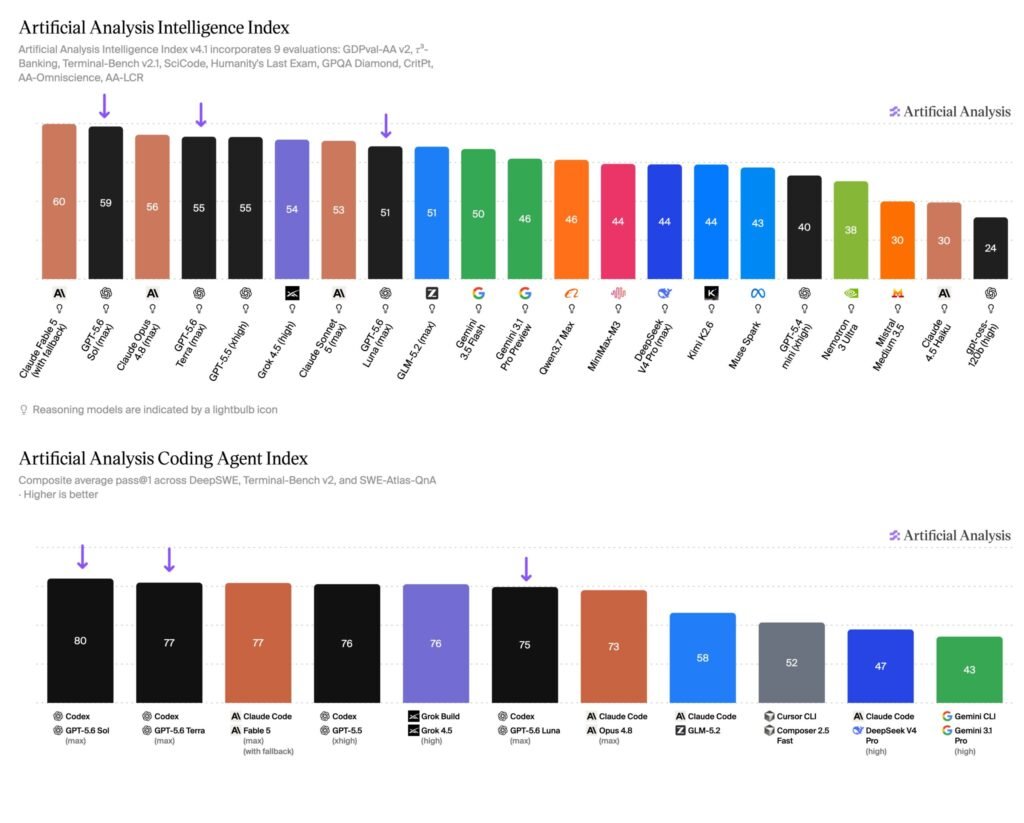
Independent testing puts these two models within a couple of points of each other, and the winner flips depending on which test you look at.
The vendor numbers are where it gets funny. OpenAI says Sol sets a new state of the art on its preferred coding benchmark at 80, which is 2.8 points above Fable 5, while using less than half the output tokens. Sam Altman added that Sol is 54% more token efficient on coding tasks. Meanwhile BenchLM’s aggregate has Fable 5 ahead 91 to 86, with Fable dominating SWE-bench Pro at 80% against Sol’s 64.6%. Each company’s favorite test says its own model wins. Shocking, I know.
The cleanest read comes from Artificial Analysis, which scores Fable 5 at 60 and Sol at 59 on its composite Intelligence Index. That’s a statistical tie. Flip over to agentic terminal work and Sol pulls ahead, scoring 91.9% on Terminal-Bench 2.0 against Fable’s 84.3%, and it leads most knowledge benchmarks too. Fable holds the edge on math and multimodal tasks.
The take that actually moved me came from Claire Vo, who ran her own hands-on benchmark across PRDs, prototypes, wireframes, debugging, and voice agents for Lenny’s Newsletter. Sol won her weighted index outright, and she wrote that it “broke through where Fable got stuck.” She also found Fable’s precision tipping into pedantry when she tried to collaborate with it, which matches something I’ve felt in my own sessions.
Where Fable 5 Still Wins for Me: Planning
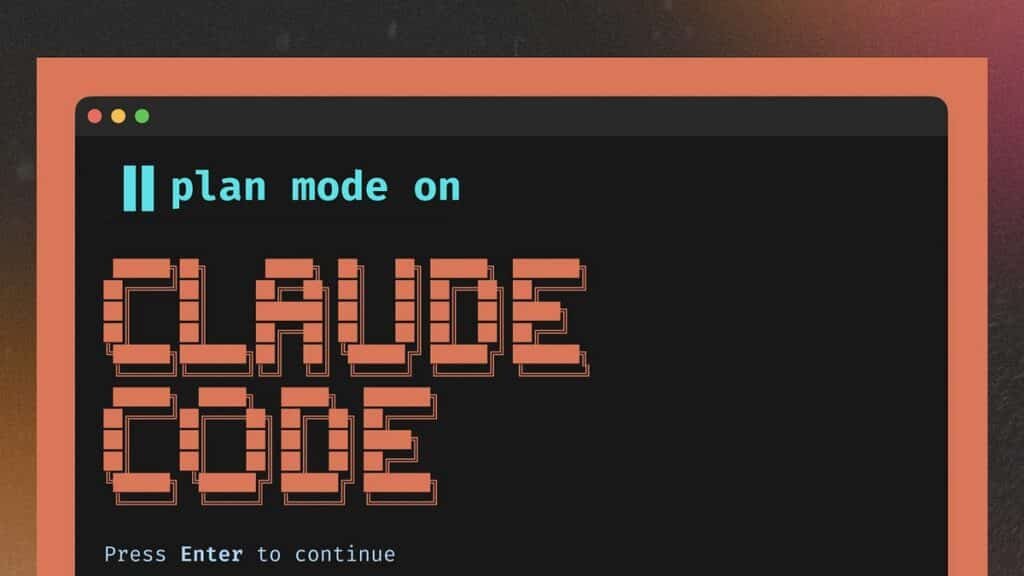
In my day-to-day Claude Code work, Fable 5 is the best planner and organizer I’ve ever used, and Opus 4.8 is still the better executor.
Here’s my honest split after a month. When I hand Fable a messy multi-step project, it maps the whole thing like an architect. It sequences the work, tracks the dependencies, routes around blockers, and comes back when it’s actually done instead of pestering me for approval every five minutes.
But when I know exactly what I want built, I still reach for Opus 4.8, and honestly Sonnet handles a lot of well-defined tasks just fine at a fraction of the usage burn. Fable can overthink a simple job. That’s the same precision-turned-pedantry thing Vo ran into. So my working setup has been Fable as the planner and Opus as the hands, and it works beautifully. It’s just expensive, which brings us to the part that made me write this post.
The Money Math Just Changed

After July 12, 2026, Fable 5 no longer draws from any Claude subscription allowance. Using it means enabling usage credits at $10 per million input tokens and $50 per million output. Sol comes included with the $20 ChatGPT Plus plan.
Anthropic has been slow-walking this deadline for weeks. The included period was supposed to end June 22, then Forbes covered the extension that kept Fable available on Pro, Max, and Team plans for up to half your weekly usage limits through July 12. After that, TechTimes reports it switches to metered credits you enable in the Claude Console with a monthly spending cap, and there’s no grace period. The day it flips, Fable simply stops responding unless credits are on.
Now stack that against OpenAI’s setup. Sol is included with ChatGPT Plus at $20 a month on medium and higher effort settings, and the $200 Pro tier adds Sol Pro plus an Ultra mode that coordinates multiple agents, per 9to5Mac. Through the API, Sol costs exactly half of Fable’s credit rates.
Here’s what that means in practice. At credit prices, $100 buys you roughly two million output tokens of Fable before you’ve even counted input. One of my heavier Fable sessions plus a parallel Opus window emptied my entire $100 Max allowance back when Fable was still included. If Sol genuinely performs at Fable’s level on your work, the answer to “which one” might just be “the one already inside the plan you have.”
⚠️ Deadline: Fable 5 leaves Claude subscription allowances after July 12, 2026. If you want uninterrupted access, enable usage credits with a spending cap in the Claude Console before then.
What I’d Do Right Now

If you already pay for ChatGPT Plus, you have Sol right now, so test it on your real work before spending a dollar on Fable credits. If you’re on a Claude Max plan mostly for Fable, this weekend is decision time.
My own plan is simple. I’m keeping my Claude subscription because Opus and Sonnet still do my execution work, and I’m going to spend next week running Sol through the same planning tasks I’ve been handing Fable. Same projects, same prompts, and I’ll write up what happens.
If you’ve been thinking about splitting your tools anyway, this is exactly the moment a multi-tool AI stack is built for. And if Claude usage limits have been squeezing you regardless, I keep a list of Claude Code alternatives that just got a lot more relevant.
✅ Try first, pay later: Run Sol on the ChatGPT plan you already have before enabling Fable usage credits. A weekend of real tasks will tell you more than every benchmark in this post.
The Honest Limitations
The biggest caveat in this whole comparison is that I haven’t run Sol on my own projects yet, and no benchmark measures your actual workflow.
Sol is two days old as I write this. The rollout was still finishing over the past 24 hours, the early numbers are provisional, and the flat contradiction between SWE-bench Pro and Terminal-Bench should make everyone a little humble about declaring a winner. Both companies picked the chart where their model looks best, because of course they did.
My Fable praise deserves the same scrutiny. It’s one person’s month of use, mostly planning and coding inside Claude Code. If your work leans toward writing, research, or voice agents, the weights shift, and Vo still prefers Sonnet 5 for her voice work even after Sol won her overall index. One more fine-print item: the $20 Plus plan gets regular Sol on medium and higher effort settings, but Sol Pro, the maximum-quality version, stays behind the $200 Pro tier.
Common Questions About GPT-5.6 Sol vs Claude Fable 5
Is GPT-5.6 Sol better than Claude Fable 5?
They’re nearly tied on independent tests. Artificial Analysis scores Fable 5 at 60 and Sol at 59 on its Intelligence Index, a statistical tie. Sol leads terminal and knowledge benchmarks while Fable 5 leads SWE-bench Pro and math, so the winner depends on your task.
How much does GPT-5.6 Sol cost?
Sol is included with ChatGPT Plus at $20 a month, plus the Pro, Business, and Enterprise plans. Through the API it costs $5 per million input tokens and $30 per million output, half of Claude Fable 5’s usage credit rates.
Is Claude Fable 5 still included with a Claude subscription?
Only through July 12, 2026, at up to 50% of weekly limits on Pro, Max, and Team plans. After that, Fable 5 requires usage credits at $10 per million input tokens and $50 per million output, enabled in the Claude Console with a monthly spending cap.
Which model is better for coding?
The benchmarks disagree. Fable 5 leads SWE-bench Pro at 80% versus 64.6%, while Sol leads Terminal-Bench 2.0 at 91.9% versus 84.3% and is reportedly far more token efficient. In my experience Fable 5 plans complex work best while Opus 4.8 executes it, so test both on your own codebase.
That’s where I land until I’ve put Sol through a real week of work. If it plans half as well as Fable for a fraction of my current spend, this blog might have a new default model, and you’ll hear about it either way.
Related reading: Claude Fable 5 Hands On | Claude Code Pro Alternatives | New to AI? Start here
WHO WROTE THIS
Moses Smith. I write Everyday AI for people who aren’t engineers. I go try the tools, then tell you honestly whether they were worth it. Sometimes the answer is no, and that’s kind of the point.
This blog is free and has no ads. If it saved you some time, you can buy me a coffee.






Leave a Reply