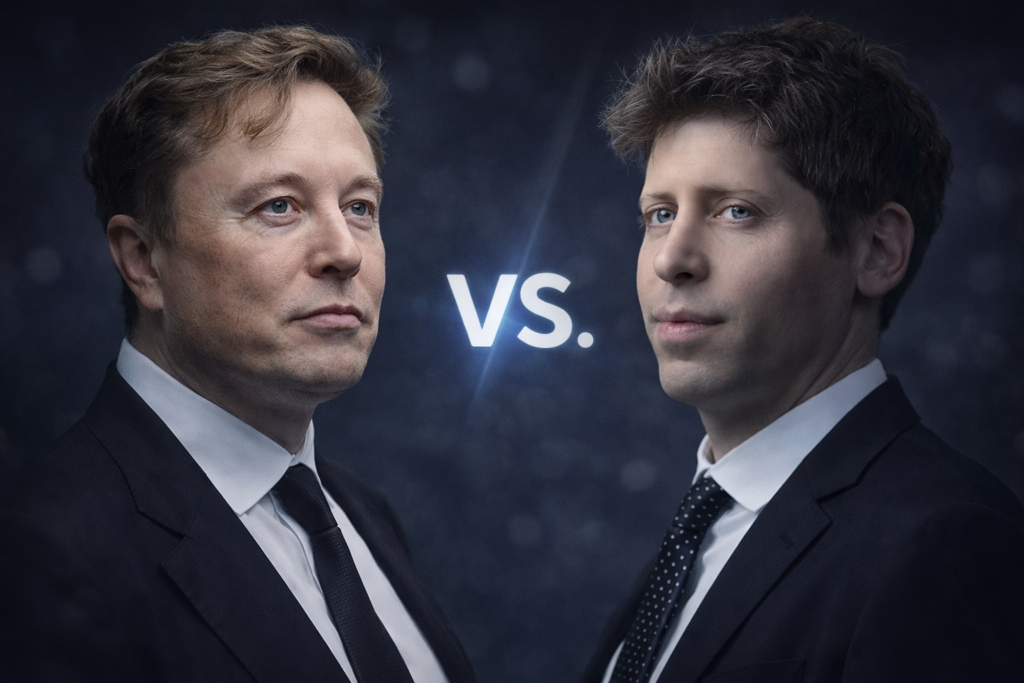
ℹ️ Quick Answer: Elon Musk and Sam Altman co-founded OpenAI in 2015 as a nonprofit to develop AI for humanity’s benefit. Musk left the board in 2018 after losing a power struggle over control. When OpenAI partnered with Microsoft and became a capped-profit company, Musk sued, alleging fraud and breach of their founding agreement. The trial begins April 27, 2026.
📋 WHAT’S INSIDE
- How the Elon Musk and Sam Altman OpenAI Partnership Started
- The Fight Over Control That Led to the Lawsuit
- OpenAI Partners with Microsoft After Musk Leaves
- Leaked Text Messages from the Elon Musk OpenAI Lawsuit
- Elon Musk OpenAI Lawsuit Timeline
- What Happens Next in the Musk vs Altman Trial
The Elon Musk OpenAI lawsuit keeps making headlines. I keep seeing Musk and Sam Altman going at each other online. Musk calls him “Scam Altman.” Altman fires back with “skill issue.” The whole thing reads like a messy divorce playing out on social media.
But here is what confused me. I thought these two were friends. They literally built OpenAI together. So what happened?
I went down a rabbit hole researching their history. Court documents. Leaked text messages. Private diary entries that were never supposed to be public. The Elon Musk OpenAI lawsuit turned out to be one of Silicon Valley’s messiest breakups, and the origin story explains everything.
How the Elon Musk and Sam Altman OpenAI Partnership Started
Google’s $500 million DeepMind acquisition in 2014 terrified Musk, who recruited Altman from Y Combinator to co-found OpenAI as a nonprofit AI lab that would keep the technology open and out of corporate control.
In 2014, Google acquired DeepMind for $500 million. That purchase terrified Musk. He believed concentrating AI development inside a single profit-driven corporation posed an existential threat to civilization.
Musk reached out to Altman, then running the startup accelerator Y Combinator. In a May 2015 email, Altman pitched his idea. Create a nonprofit AI lab that would act as a counterweight to Google. The technology would belong to the world, not shareholders. Musk responded simply. “Probably worth a conversation.”
By December 2015, OpenAI officially launched. The founding team included Altman, Musk, Greg Brockman, and Ilya Sutskever. Musk personally came up with the name “OpenAI” to reflect their commitment to openness. He pledged to cover whatever funding others did not provide and eventually donated between $38 million and $44 million, roughly 60 percent of the company’s early capital.
If you are new to how AI assistants work, OpenAI is the company behind ChatGPT, the tool that brought AI into mainstream conversation.
The Fight Over Control That Led to the Lawsuit
Musk proposed taking majority equity, board control, and the CEO role when OpenAI discussed going for-profit in 2017. The other founders refused, and Musk left the board in February 2018 after a failed bid to merge OpenAI into Tesla.
By 2017, the founders realized they had a problem. Building artificial general intelligence would require billions of dollars. A nonprofit structure could not raise that kind of money through donations alone.
Musk agreed that transitioning to a for-profit model made sense. In a July 2017 message, he wrote “100% agreed” when Greg Brockman proposed the shift. But Musk wanted something in return. Majority equity, initial board control, and the CEO position.
The other founders refused. They believed giving any single person absolute control over AGI technology would defeat the entire purpose of their mission. In their response to Musk, they wrote. “The goal of OpenAI is to make the future good and to avoid an AGI dictatorship.”
On September 20, 2017, Altman responded to Musk’s demands. “I remain enthusiastic about the non-profit structure!” Musk replied. “Discussions are over.”
Musk made one final proposal in January 2018. He suggested OpenAI should “attach to Tesla as its cash cow.” The team rejected becoming a Tesla subsidiary. On February 21, 2018, OpenAI announced Musk was leaving the board, citing potential conflicts of interest with Tesla’s AI efforts.
OpenAI Partners with Microsoft After Musk Leaves
After Musk’s departure, OpenAI created a capped-profit subsidiary in 2019 and took $1 billion from Microsoft, eventually growing to $11 billion in Microsoft investment with exclusive commercial rights and Azure as the sole cloud provider.
With Musk gone, OpenAI found a different path to billions. In March 2019, the company created a “capped-profit” subsidiary that allowed investors to earn returns capped at 100 times their investment.
Four months later, Microsoft invested $1 billion. By January 2023, Microsoft had invested an additional $10 billion. The partnership gave Microsoft exclusive commercial rights to OpenAI’s pre-AGI technology and made Azure the company’s exclusive cloud provider.
This was exactly what Musk had warned against. OpenAI had gone from an open nonprofit to what he called “a closed source, maximum-profit company effectively controlled by Microsoft.” That betrayal is the core of the Elon Musk OpenAI lawsuit.
Leaked Text Messages from the Elon Musk OpenAI Lawsuit
Unsealed court documents revealed over 100 private exchanges, including Altman texting Musk “it really fucking hurts when you publicly attack openai” and Greg Brockman’s diary entry questioning whether the nonprofit commitment was “a lie.”
Court filings unsealed over 100 documents showing private communications between the key figures. The exchanges reveal just how personal this fight became.
In February 2023, after Musk publicly criticized OpenAI, Altman texted him. “you’re my hero and that’s what it feels like when you attack OpenAI. it really fucking hurts when you publicly attack openai.”
Musk replied. “I hear you and it is certainly not my intention to be hurtful, for which I apologize, but the fate of civilization is at stake.”
The most damaging revelation came from Greg Brockman’s private diary. In November 2017, as the founders discussed transitioning away from nonprofit status, Brockman wrote. “I cannot believe that we committed to non-profit if three months later we’re doing b-corp then it was a lie.”
Elon Musk OpenAI Lawsuit Timeline
Musk first sued in February 2024, withdrew in June after hugging Altman at a conference, then refiled in August with expanded antitrust claims naming Microsoft and his own company xAI as co-plaintiff. Trial is set for April 27, 2026.
On February 29, 2024, Musk filed his first lawsuit against Altman, Brockman, and OpenAI, alleging breach of contract and fraud. He claimed the founders had deceived him about keeping OpenAI a nonprofit.
Then something strange happened. On June 11, 2024, one day before a hearing on OpenAI’s motion to dismiss, Musk withdrew the lawsuit. Reports emerged that he and Altman had met privately at a Montana tech conference and shared a hug.
The peace did not last. On August 5, 2024, Musk refiled in federal court with expanded claims. By November 2024, he had amended the complaint to add antitrust allegations, name Microsoft as a defendant, and add his AI company xAI as a co-plaintiff.
OpenAI called it a “campaign of harassment” designed to slow them down while Musk’s competing company Grok catches up.
What Happens Next in the Musk vs Altman Trial
Judge Yvonne Gonzalez Rogers denied OpenAI’s motion to dismiss on January 15, 2026, finding “plenty of evidence” for a jury trial starting April 27. The jury will decide whether OpenAI’s shift to for-profit status constituted fraud.
On January 15, 2026, U.S. District Judge Yvonne Gonzalez Rogers denied OpenAI’s motion to dismiss, stating there was “plenty of evidence” to let a jury decide. She set the trial date for April 27, 2026.
The jury will determine whether OpenAI’s leaders made binding promises about keeping the company nonprofit, whether Musk relied on those promises when contributing millions, and whether the shift to for-profit status constituted fraud.
Meanwhile, OpenAI completed a major restructuring in October 2025. The nonprofit foundation now holds 26 percent equity in the for-profit OpenAI Group, with Microsoft holding 27 percent. The transformation Musk warned against is now complete.
No matter who wins in court, this fight has already changed the conversation around AI companies and nonprofit promises. Two guys who once emailed about saving the world from Google are now spending millions trying to destroy each other. And the trial hasn’t even started yet.
WHO WROTE THIS
Moses Smith. I write Everyday AI for people who aren’t engineers. I go try the tools, then tell you honestly whether they were worth it. Sometimes the answer is no, and that’s kind of the point.
This blog is free and has no ads. If it saved you some time, you can buy me a coffee.