ℹ️ Quick Answer: Your AI assistant stack in 2026 should split tasks across specialized tools instead of forcing one chatbot to do everything. Use ChatGPT for daily questions and voice, Perplexity for cited research, Claude for coding and deep reasoning, and Gemini for Google ecosystem tasks. Total cost runs about $80 per month for tools you’ll use dozens of times a day.
What’s inside
- Research. Perplexity, and Nobody Else
- Coding. Claude Has Pulled Away
- The Daily Driver. ChatGPT Still Wins on Breadth
- Google Users. Gemini Is Your Ambient Layer
- The One to Watch. Grok and the X Factor
- My Actual Stack and What It Costs
- Honest Limitations
- Common Questions
I have four AI subscriptions running right now. Five if you count the API credits. A year ago I would have felt ridiculous about that. Today it feels like the minimum.
Nobody writes “ChatGPT vs Claude vs Gemini” comparison posts that actually help, because the comparison itself is wrong. These tools aren’t competing for the same job anymore. They’ve specialized. Asking which AI is best in 2026 is like asking whether a drill or a saw is better. Depends what you’re building.
I’ve spent the last year splitting my workflow across different AI assistants. What I ended up with is less of a “best AI” pick and more of a roster. Here’s how I divided it up.
Research. Perplexity, and Nobody Else
Perplexity is the only AI tool I trust for factual research.
Every time I need to answer a factual question, Perplexity is where I go. Not ChatGPT. Not Claude. The reason is citations. Numbered and linked sources that I can click and check myself. When ChatGPT tells me something, I get confident prose that may or may not be hallucinated. Perplexity shows me where it found it.
Deep Research mode is the killer feature. You ask a question, it runs a multi step investigation across dozens of sources, and hands you a structured answer with everything cited. I used it to research the platforms for this very post. If you’ve seen what Perplexity Computer can do, you know they’re pushing way beyond basic search.
Pro costs $20 per month. Max runs $200 per month for unlimited everything. People keep asking me about Google NotebookLM as an alternative. I’ve tried it. It gathers sources well, but getting usable answers out of it felt like extra work compared to Perplexity. Could become a real rival, but it’s not there yet.
Coding. Claude Has Pulled Away in the AI Assistant Stack
For coding and deep reasoning over large documents, Claude is the best tool available in 2026. The context handling is what separates it.
I write code with Claude Code, the CLI tool that runs in your terminal, reads your codebase, edits files, and runs tests. It feels less like autocomplete and more like pair programming with someone who actually read the repo. The model underneath (currently Claude Opus 4.6 or Sonnet 4.6) handles the reasoning, but the tooling around it is what makes the difference.
The 1 million token context window means Claude can hold an entire codebase in working memory during a session. Not a summary. The actual files. I’ve had sessions where it tracked continuity across 50+ files without dropping a detail.
ChatGPT has Codex, which is solid. GitHub Copilot is still the dominant autocomplete tool. But for agentic coding, where the AI plans, executes, tests, and iterates on its own, Claude Code is the best tool I’ve used. Don’t ask your surgeon to do your taxes.
The Daily Driver in Your AI Assistant Stack. ChatGPT Still Wins on Breadth
ChatGPT is still the best general purpose AI for everyday tasks. Between the memory, the voice mode, and how many things it plugs into, it does the most stuff acceptably well.
If I need to ask a quick question, I’m not going to fire up Claude Code for that. ChatGPT is just faster for the everyday stuff. Random questions, brainstorming, those “help me think through this” conversations where you don’t even know what you’re asking yet. GPT-5 is the everyday model now, with reasoning models like o3 and o4 mini available when you need step by step thinking.
One feature that doesn’t get enough attention is the GPTs section. Custom chatbots tailored to specific tasks. When I was running a YouTube channel, I found a GPT that turned video description writing from a 30 minute task into a 5 minute copy paste job. That library of specialized mini bots is something none of the other platforms have matched.
Voice mode is another edge. I use it while cooking, sometimes just pacing around the house trying to think through a problem out loud. For a daily assistant, being able to talk instead of type matters more than most people realize until they try it.
Google Users. Gemini Is Your AI Assistant Stack’s Ambient Layer
Gemini is the AI that’s already inside your Google apps. That’s where it’s useful. As a standalone chatbot, it’s just okay.
If you live in Google’s ecosystem (Gmail, Drive, Docs, Calendar, Photos), Gemini understands your life without you having to explain it. The big move in early 2026 was Personal Intelligence, which connects Gemini to your Google data as a layer underneath your apps. “Summarize the thread with the contractor.” “What’s on my calendar tomorrow that conflicts with this meeting?” Gemini answers these because it already has the context.
AI Pro at $19.99 per month unlocks Gemini 3 and Workspace integration. The Apple Siri integration is interesting too. Apple signed a multi billion dollar deal with Google to power Siri with Gemini behind the scenes, so iPhone users in Google’s ecosystem get access through Siri without even realizing it.
The whole reason Gemini works for me is that it already knows my stuff because my stuff lives in Google. If you use Outlook and iCloud Drive, skip it.
The One to Watch in the AI Assistant Stack. Grok and the X Factor
I haven’t used Grok. Full disclosure up front. But when a platform tops LMArena in blind preference testing and has direct access to everything being posted on X in real time, I can’t just skip it. So I researched it instead.
Grok is built by xAI, and the current flagship is Grok 4. What makes it different from everything else on this list is live access to X. Every other AI has some version of web search. Grok has a direct pipeline into what millions of people are posting right now. Not an hour ago. Right now.
SuperGrok runs $30 per month, which is 50% more than ChatGPT Plus. The free tier gives you basic Grok on X, which is enough to kick the tires.
So what’s the catch? From everything I’ve read, Grok’s strengths are concentrated in real time awareness and technical reasoning. For general writing and everyday conversation, most reviews say it isn’t quite there yet. The tooling ecosystem is thinner. No equivalent to ChatGPT’s GPTs library or Claude Code’s agentic workflows. And the real time X integration cuts both ways. When X has outages, Grok’s live features go dark too.
Grok isn’t in my stack yet. But if you spend a lot of time on X or need real time pulse checks on public conversation, it fills a gap the other four don’t touch. If xAI can get the general quality closer to ChatGPT or Claude while keeping that live data access, I’ll probably end up adding a fifth subscription.
My Actual Stack and What It Costs
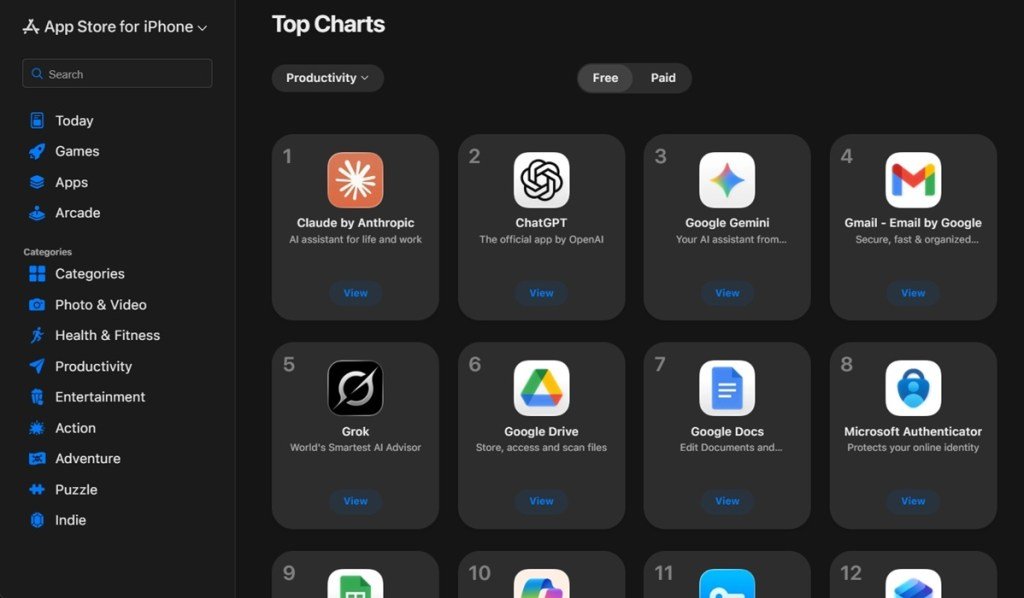
ChatGPT Plus ($20/mo) is my home screen for quick questions, brainstorming, and voice. Perplexity Pro ($20/mo) gets every research task. Claude Pro plus Claude Code ($20/mo) handles coding and anything requiring deep context. Gemini runs inside my Google apps and I barely notice it. I’ve tried consolidating twice. Both times I moved tasks back within a week.
Total monthly cost. Roughly $80, sometimes $160 when I’m on Claude MAX. Whether that’s worth it depends on how much time they save you. For me it’s not even a question anymore.
Honest Limitations
$80 per month adds up. That’s nearly $1,000 a year on AI tools alone. I’d tell most people to start with ChatGPT Plus and Perplexity Pro for $40 total, then add from there only when something specific frustrates you enough.
Context switching is real. Last week I wasted fifteen minutes trying to get ChatGPT to help me fact check an article I wrote before remembering that’s literally not what it’s for. It takes about two weeks before the muscle memory kicks in.
Also, none of these tools talk to each other. Your Perplexity research doesn’t flow into Claude automatically. There’s no shared clipboard, no handoff protocol. You’re copying and pasting between tabs like it’s 2019. Whoever solves that interop problem first is going to make a lot of money.
Common Questions

Can I just use ChatGPT for everything?
Yeah, and most people do. It handles maybe 80% of tasks well enough. If you write code, Claude Code is noticeably better. If you do a lot of research, Perplexity’s citations will save you hours. Start with ChatGPT. Add specialists only when something annoys you enough.
What’s the cheapest way to start?
ChatGPT Plus and Perplexity Pro. $40 a month. Free tiers of Claude and Gemini fill the gaps while you figure out if they’re worth upgrading.
Is Grok worth $30 a month?
Only if you value real time data from X. Journalists, social media managers, and anyone tracking fast moving public conversations will find Grok’s live access useful. Everyone else gets more value from ChatGPT Plus at $20.
Will this stack still be relevant in six months?
The specific tools will shift. Some model will leap ahead, some pricing will change. But splitting tasks across specialized tools instead of relying on one chatbot? I don’t see that reversing.
I’m curious what other people are running. Same split? Completely different? Drop a comment or send me a message. This will probably be outdated by summer, but that’s the deal now.
Related reading: 5 AI Agent Workflows Worth Automating First | 5 Ways to Use Claude Code Without Writing Code | Developers Are Switching to OpenAI Codex | New to AI? Start here
WHO WROTE THIS
Moses Smith. I write Everyday AI for people who aren’t engineers. I go try the tools, then tell you honestly whether they were worth it. Sometimes the answer is no, and that’s kind of the point.
This blog is free and has no ads. If it saved you some time, you can buy me a coffee.