
ℹ️ Quick Answer: Claude Code usage limits drop about 17% on September 14, when a temporary 50% boost ends and a smaller permanent 25% increase replaces it. Fable 5.1 is cheaper to run, but that discount lands on token billing, not on your subscription. The setting that actually buys back room is effort level, and it defaults to High.
📋 WHAT’S INSIDE
- Claude Code usage limits: what actually changes on September 14
- Why the Fable 5.1 price cut doesn’t land in your weekly limit
- What I’m seeing one day into 5.1
- The effort setting that buys back the most room
- Three habits that stretch your Claude Code usage limits
- What Anthropic still hasn’t told us
Last updated September 2, 2026
A few months ago I could keep five things going at once on my Max 20x plan. One window researching a topic I wanted to write about. One chewing through my banking exports and updating my budget. One editing a website, because I maintain a couple of sites for family and it’s easier to just do it than explain what I’d need them to change. They weren’t running all night, and most evenings they were sitting idle. Still, five was normal.
Now two feels like the ceiling. Before Fable 5.1 shipped, I couldn’t get through a full week on Fable running a single stream, which is a strange thing to type about a $200 plan.
So when Anthropic announced a limits change last week and framed it as an increase, a lot of people did the same double take I did. The number went up in the sentence and down in the account. Here’s what actually changed, and why the shiny new model doesn’t fix it the way you’d think.
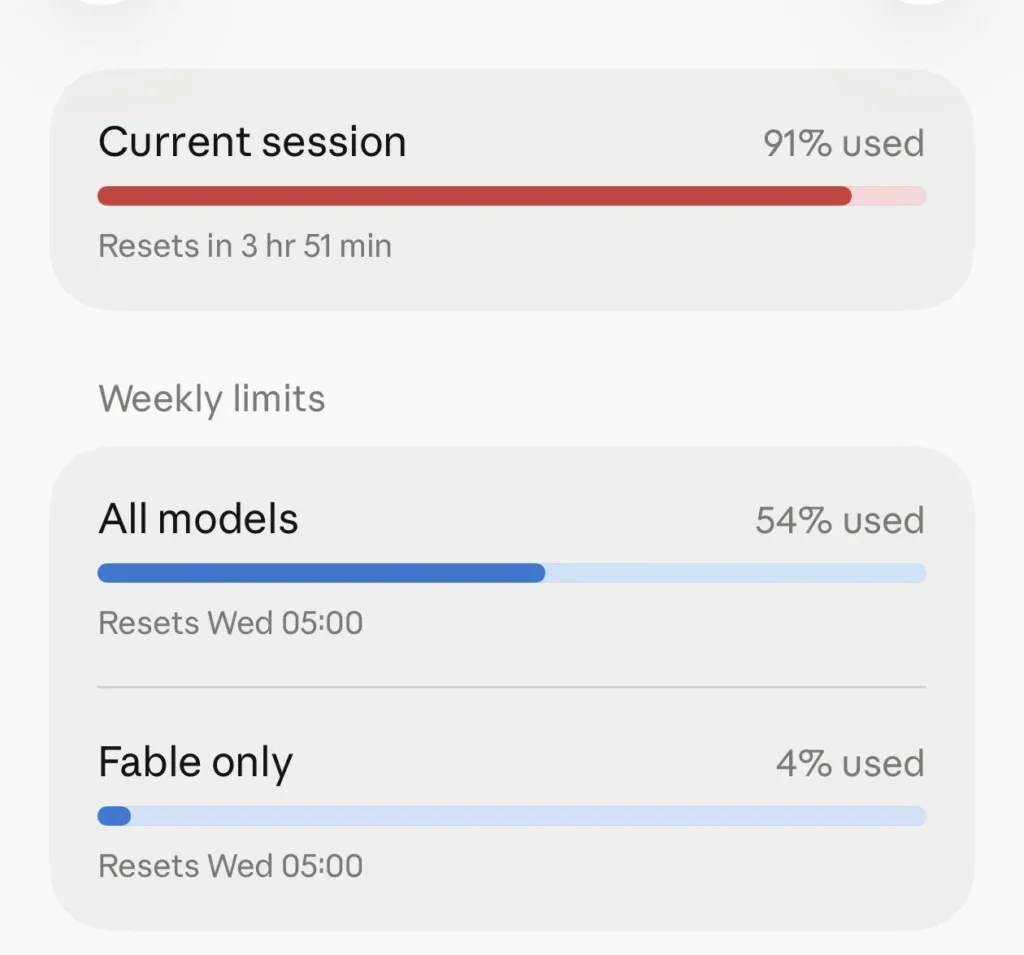
Most of what follows is about Claude Code. If you only use Claude in a browser tab, here’s the one fact worth having before you go: chat, desktop, and Claude Code all draw from the same weekly pool. The long conversation you had about dinner plans came out of the same budget as everything else.
Claude Code usage limits: what actually changes on September 14
Claude Code usage limits go up 25% against the old baseline and down about 17% against what you have in your account today. Both statements are true, which is the whole problem.

The math is simple once you pick a starting point. Call the original weekly allowance 100. A temporary 50% boost has been running since May, so today you’re sitting at 150. On September 14 the permanent baseline becomes 125. That’s a real raise over where things started and a real cut from where they are, and 125 divided by 150 lands you at roughly 17% less than you had yesterday, as BleepingComputer laid out.
The rollout deserves a mention. Anthropic posted the announcement leading with the 25% increase, deleted that thread, and posted a clarification that says it plainly: “Compared to today, this works out to a 17% reduction in weekly limits on Claude Code.” Credit where it’s due, that second post is unusually direct. The company added that it’s working on changes that will “make it feel like you’re getting more from Claude, while having more visibility and control of your usage.”
The change covers Pro, Max, Team, and seat-based Enterprise plans. The current boost stays live through September 13. The Decoder summed the framing up as a raise on paper and a cut in practice.
Why the Fable 5.1 price cut doesn’t land in your weekly limit
Fable 5.1 really is cheaper to run, by about 25% on typical work and up to 45% on heavy agentic work. That saving shows up on token-billed usage like the API. Your Max subscription isn’t billed by token, so the discount and the limit cut are measured in two different currencies and don’t cancel each other out.
The Fable 5.1 launch post says they reduced the price of cache reads “wherever usage is billed by token, such as on our API.” That last clause is the part that matters. Cache reads dropped from $1.00 to $0.25 per million tokens, a 75% cut, while the headline price stayed at $10 in and $50 out. If you’re paying per token, that’s a genuinely large saving.
If you’re on a subscription, you never saw those cache reads on a bill in the first place. Anthropic’s own usage limit guidance says cached content that gets reused doesn’t count against your limits, so the price of a cache read was already zero to you. Making zero cheaper doesn’t give you more room.
There’s no published exchange rate between “45% cheaper on the API” and “how many hours of Claude Code you get on a Tuesday.” Only Anthropic can do that conversion, and it hasn’t.
What I’m seeing one day into 5.1
My honest read is that 5.1 does seem to go further per unit of limit, and there’s a plausible reason for that which has nothing to do with cache pricing. It’s early though, and I want to be upfront about how early.

Fable 5.1 shipped on September 1. I’ve been on it since release, which as I write this is about a day. That is not enough time to say anything about a weekly limit with a straight face, and I’ll update this post once I’ve actually run a full week on it. What I can say is that it’s burning through work faster and asking me to re-explain myself less.
The benchmarks point the same direction, with the usual caveats. Fable 5.1 jumps from 42.0% to 55.8% on Terminal-Bench 4.0, and roughly doubles Fable 5’s score on the agentic science benchmark. Anthropic reports a standard error of about four points on that second one and doesn’t publish one for the first, so the direction is more trustworthy than the size of either gap. All of it is self-reported and not independently verified yet, which LLM Stats flags clearly.
My guess at the mechanism, and I want to be clear it’s a guess: a model that gets the task right the first time doesn’t spend your allowance on the second and third attempt. Every wrong turn you don’t have to correct is capacity you keep. I haven’t measured it, and going from a benchmark score to hours of headroom is a leap I can’t make with any confidence yet.
The effort setting that buys back the most room
Fable 5.1 defaults to High effort inside Claude Code, and effort level is one of the things Anthropic lists as driving how fast you burn your allowance. Dropping to Medium is the single biggest lever most people aren’t touching.
Anthropic says it out loud on the launch page: at Low or Medium effort, Fable 5.1 gets results similar to or better than Fable 5 managed, at much lower cost. Read that next to the default and the implication is hard to miss. Claude Code is handing you the most expensive setting by default, on a model good enough that its cheaper settings now match what Fable 5 was doing at full tilt.
You change it with the /effort command in Claude Code. Anthropic’s launch page notes that 5.1 already defaults to Medium on claude.ai and in Claude Cowork, its newer work assistant. Medium isn’t a degraded mode, it’s what most of Anthropic’s own surfaces picked as the sensible middle.
✅ Try this first: Run /effort medium in Claude Code and work normally for a few days. If the output quality holds for what you actually do, you’ve absorbed most of the September 14 cut without changing anything else.
Three habits that stretch your Claude Code usage limits
Beyond effort level, the things that move the needle are conversation length, model choice, and how much you make Claude re-read. All three are in your hands.
Start fresh sessions more often
Anthropic lists conversation length and complexity as direct inputs to how much of your limit a message costs. A session you’ve been adding to all afternoon is dragging its whole history along on every turn. When you switch to an unrelated task, start a new session instead of continuing the old one.
Don’t reach for the biggest model by reflex
Model choice is on the same list. Renaming variables, writing a commit message, and reformatting a file don’t need the model that scores 55.8% on agentic terminal work. I keep the heavy model for the thing I’m actually stuck on and let something lighter handle the rest.
Let caching do its job
Reused content that’s already cached doesn’t count against your limits. That rewards keeping your reference material stable and in one place rather than pasting it in fresh every time. Anthropic’s own tip is that the more you reuse the same content, the more you get back.
What Anthropic still hasn’t told us
The honest answer to “how much Claude do I get” is still that nobody will tell you in units you can count. That opacity bothers me more than the 17% does.
Anthropic says directly that the weekly allowance doesn’t translate into a fixed number of prompts, because usage depends on conversation length, model, tool use, and effort. That’s technically fair and practically maddening. You can’t budget against a number nobody publishes, which is why the forums fill up with people comparing gut feelings instead of receipts.
This isn’t new either. Back in January, developers hit surprise limits and Anthropic pointed at an expiring bonus, which is close to the same shape as what’s happening now. A boost arrives, people build habits around it, the boost expires, and the expiry feels like a punishment even when the baseline genuinely improved.
⚠️ Before you cancel: The promised visibility and control features haven’t shipped, so there’s nothing to evaluate yet. If you’re on the fence, the informative test is one normal week on 5.1 at Medium effort after September 14, not the week before it.
The thing I’ll be watching is whether those transparency changes turn into an actual usage meter. Give people a number that goes down and most of this argument disappears, because then you can plan. Until then everybody’s estimating, including me.
When exactly do Claude Code usage limits change?
The current 50% temporary boost stays in place through September 13, 2026. On September 14 the new permanent baseline takes effect at 25% above the original limits, which works out to roughly 17% less capacity than subscribers have today. It applies to Pro, Max, Team, and seat-based Enterprise plans.
Does Fable 5.1 being cheaper mean I get more usage on my subscription?
Not directly. Anthropic’s cache read discount applies wherever usage is billed by token, such as the API, and a Pro or Max subscription is not billed by token. Cached content that gets reused already did not count against subscription limits. You may still get more done because 5.1 performs better and may need fewer retries, but that would be a different mechanism than the price cut, and it has not been measured.
What is the fastest way to make my Claude Code limit last longer?
Lower the effort level. Fable 5.1 defaults to High effort in Claude Code, and Anthropic says the model at Low or Medium effort matches or beats Fable 5 at much lower cost. Run /effort medium and see whether quality holds for your work. After that, start fresh sessions for unrelated tasks and stop using the largest model for small edits.
Do claude.ai and Claude Code share the same usage limit?
Yes. Anthropic confirms that usage across claude.ai, Claude Desktop, and Claude Code all counts toward the same limit. Long chat conversations reduce the capacity available for coding work in the same period.
The cut is real, the model is better, and neither one tells you much about the other. Turn the effort dial down, give it a week, and judge it on what you actually got done.
Related reading: How Fable 5 split the Claude plans | Claude Opus 5 at half the price | What ChatGPT’s free limits actually cover | New to AI? Start here
WHO WROTE THIS
Moses Smith. I write Everyday AI for people who aren’t engineers. I go try the tools, then tell you honestly whether they were worth it. Sometimes the answer is no, and that’s kind of the point.
This blog is free and has no ads. If it saved you some time, you can buy me a coffee.









Leave a Reply