
ℹ️ Quick Answer: Claude Opus 5 is Anthropic’s newest model, released July 24, 2026. It comes close to the intelligence of the company’s top model, Claude Fable 5, at half the price. It’s the new default on Claude Max, the strongest option on Claude Pro, and it’s live in Claude.ai, the API, and Claude Code.
📋 WHAT’S INSIDE
- What Claude Opus 5 Is
- Where It Sits on the Frontier
- What People Are Finding
- What It Means for You
Last updated July 24, 2026
Anthropic dropped a new model today, and the pitch is refreshingly plain. Claude Opus 5 gets close to the smarts of its frontier model, Claude Fable 5, while costing half as much to run. If you pay for Claude, this is the model you’re now getting by default.
That’s a change in tone. Anthropic’s recent launches were about beating rival labs. This one is about beating its own top model on price, a bet that most real work doesn’t need the absolute frontier.
What Claude Opus 5 Is
Claude Opus 5 is a near-frontier model built for everyday use. It matches Anthropic’s flagship, Fable 5, closely on coding and knowledge work while costing half as much, and it’s now the default model on the Claude Max plan.
The price is the headline. Opus 5 runs $5 per million input tokens and $25 per million output, the same as Opus 4.8 and half of Fable 5’s $10 and $50. For most people that’s abstract, so in plain terms: on Claude Pro and Claude Max, Opus 5 is now the strongest model you can pick, and you’re not paying extra for it.
It’s live everywhere Anthropic ships, from Claude.ai to the Claude API to Claude Code. There’s also a Fast mode that runs about 2.5 times quicker for twice the base price, for the times speed matters more than cost.
Where Claude Opus 5 Sits on the Frontier

On the frontier map, Claude Fable 5 is Anthropic’s most capable model and Mythos 5 leads on security tasks. Claude Opus 5 sits just below them as the strong, cheaper everyday pick, and it’s the new state of the art on coding and knowledge-work benchmarks.
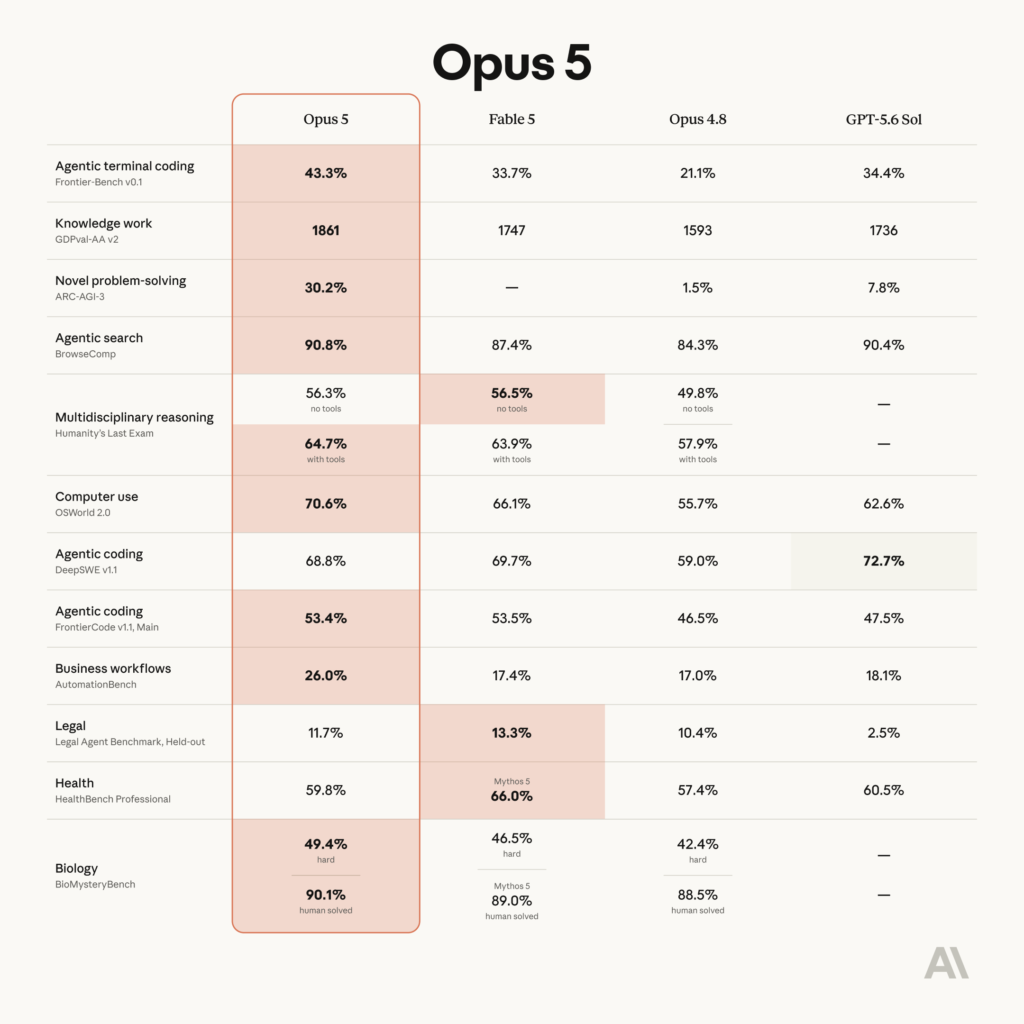
The benchmarks back the pitch up. On Frontier-Bench, Opus 5 more than doubles Opus 4.8’s score at a lower cost per task. On CursorBench it lands within half a point of Fable 5’s best result at roughly half the cost. The number that turned heads is ARC-AGI-3, a test built around genuinely new problems rather than familiar patterns, where Opus 5 scores three times higher than the next-best model.
The one place it doesn’t lead is cybersecurity, where Mythos 5 stays ahead. For the knowledge work most people and businesses actually do with AI, the coding and writing and analysis, Opus 5 is at or near the top.
What People Are Finding
Early testers keep pointing to one trait: Opus 5 checks its own work and pushes through problems other models quietly give up on.
Anthropic shared a few examples that stand out. Given a drawing of a machine part with no way to actually see the image, Opus 5 wrote its own computer vision code to pull the shape from raw pixels, then rebuilt the part as a 3D model. No other model in the same setup could do it in five tries.
On a real bug in a popular software package manager, it found the actual root cause and fixed an edge case the community’s own patch had missed, while a rival model only patched the surface symptom and called it done. Another engineer used it to build a live market data feed for a new exchange in a single session, and when there was nothing to test against, Opus 5 built its own test harness to check its work.
What Claude Opus 5 Means for You

If you pay for Claude, you already have Claude Opus 5, and it’s the best model on your plan at no extra cost. If you build with the API, you get near-frontier quality at half the price of Anthropic’s top model.
For everyday Claude users, there’s nothing to do. Open the app and Opus 5 is there, set as the default on Max and available on Pro. You get a smarter assistant for the same subscription you already pay.
For developers and small businesses, the math is the real story. Near-frontier coding and analysis at $5 and $25 per million tokens means the quality that used to sit behind a premium price is now the everyday option. That’s the whole point of this release, and it’s why the launch leaned on cost instead of another round of “we beat everyone” charts.
Is Claude Opus 5 free?
Claude Opus 5 is available on Anthropic’s paid plans. It’s the default model on Claude Max and the strongest option on Claude Pro, and developers can use it through the Claude API at $5 per million input tokens and $25 per million output. Anthropic hasn’t put its Opus models on the free tier before, so free users generally get a smaller model.
Is Claude Opus 5 better than Fable 5?
Not overall. Anthropic positions Fable 5 as its most capable model and Claude Opus 5 as a near-frontier model that comes close for half the price. On some coding and knowledge-work benchmarks Opus 5 leads, but Fable 5 is still the top tier for the hardest work.
How much does Claude Opus 5 cost?
On the API, Claude Opus 5 costs $5 per million input tokens and $25 per million output tokens, the same as Opus 4.8 and half of Fable 5. A Fast mode runs about 2.5 times quicker at twice the base price. In the apps, it’s included with Claude Pro and Claude Max.
The headline here is the price, not the raw power. If you already pay for Claude, open it and see what the new default can do.
Related reading: Claude Fable 5 hands on | GPT-5.6 Sol vs Claude Fable 5 | How Claude’s plans changed | New to AI? Start here
WHO WROTE THIS
Moses Smith. I write Everyday AI for people who aren’t engineers. I go try the tools, then tell you honestly whether they were worth it. Sometimes the answer is no, and that’s kind of the point.
This blog is free and has no ads. If it saved you some time, you can buy me a coffee.









Leave a Reply